






Zuckerberg AI Manifesto: Who Is Paying for the AI Boom?
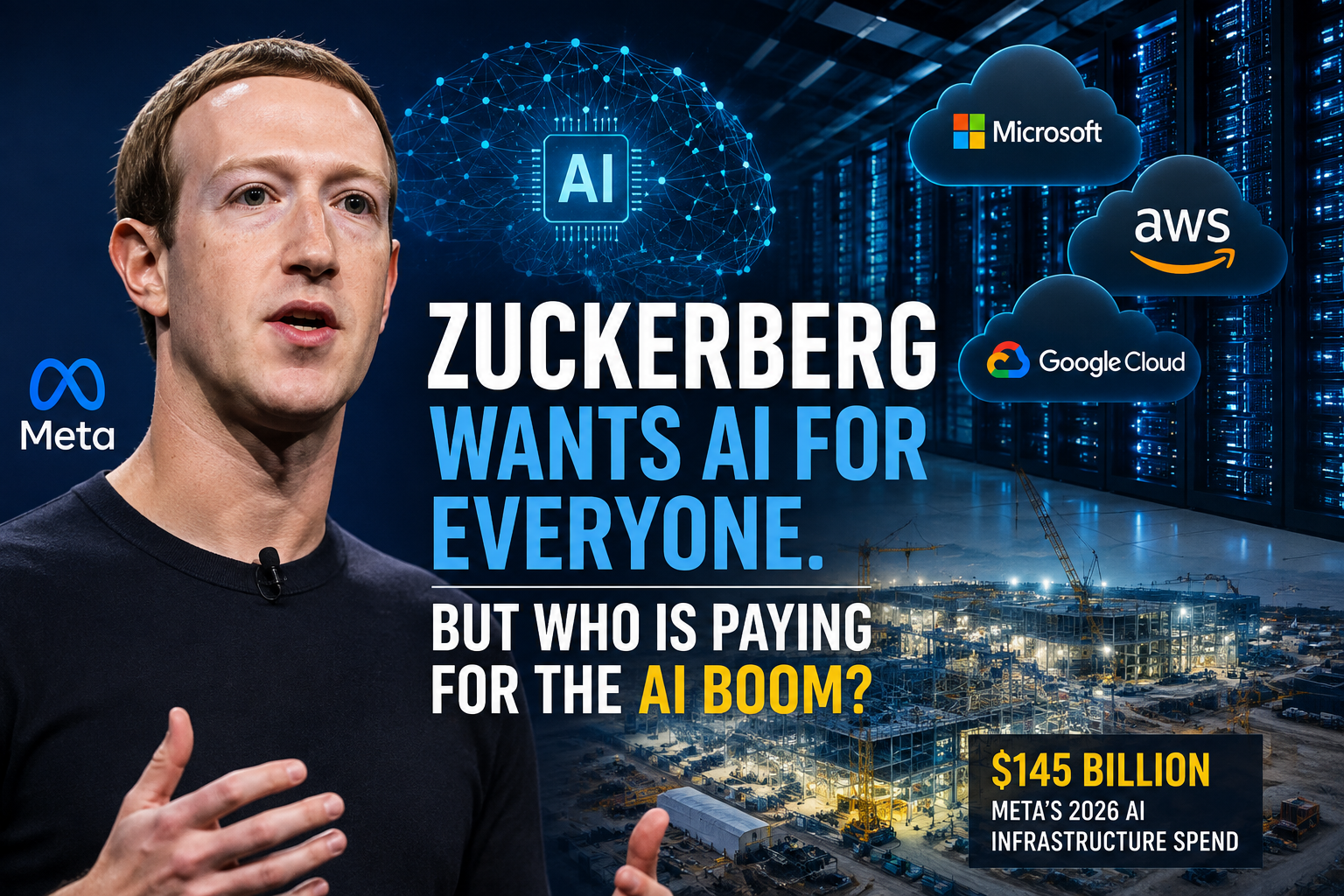
Zuckerberg Wants AI for Everyone. But Who Is Paying for the AI Boom?
Meta CEO Mark Zuckerberg has laid out an ambitious vision for the future of artificial intelligence: advanced AI should be available to everyone, not controlled by a small group of technology companies.
In his 6,000-word essay, “The Future Is for Everyone,” Zuckerberg argues for open-weight AI models that developers, businesses and individuals can use to build their own tools.
But there is another side to this AI revolution that is harder to see: the enormous amount of money being spent to build the infrastructure behind it.
AI Is Becoming a Very Expensive Business
Building powerful AI systems requires huge data centres, specialised chips, electricity and cloud computing.
Meta expects to spend up to $145 billion on capital expenditure in 2026, while Microsoft, Amazon and Google are also investing heavily in AI infrastructure.
These companies are not just building infrastructure for themselves. Their cloud businesses are also selling computing power to AI companies.
That creates an unusual relationship.
AI Companies Need the Cloud. Cloud Companies Need AI Demand.
Companies such as OpenAI and Anthropic need enormous amounts of computing power to train and operate their AI models.
Much of that computing comes from major cloud providers, including Microsoft Azure, Amazon Web Services and Google Cloud.
At the same time, those cloud companies are investing billions of dollars in new infrastructure because they expect AI demand to keep growing.
So the cycle looks something like this:
AI companies need computing → cloud companies provide it → cloud companies build more capacity → AI companies sign bigger contracts.
According to estimates cited in the Jefferies material supplied for this story, OpenAI and Anthropic are already becoming significant customers for the major cloud platforms.
The exact percentages are estimates and should be verified against the original Jefferies report before publication.
Is This a Problem?
Not necessarily.
AI companies are also generating rapidly increasing revenues. If businesses and consumers continue paying for AI products, the enormous infrastructure spending could eventually be supported by genuine economic activity.
But there is a risk.
If AI demand grows more slowly than expected, cloud companies could be left with expensive data centres and computing capacity built for a much larger market.
That makes AI revenue growth one of the most important things to watch.
Where Does Zuckerberg Fit Into This?
Zuckerberg’s open-weight strategy adds another dimension to the debate.
Meta wants advanced AI to reach a much wider community of developers and businesses. The company is therefore competing not only on AI models but also on the infrastructure needed to build and run them.
Meta has also expanded its AI infrastructure plans in India. In June 2026, the company announced an agreement with Reliance Industries for an AI-enabled data centre in Jamnagar, Gujarat, initially planned at 168 MW with an option to scale.
That shows how the AI race is increasingly becoming a physical infrastructure race as well.
The Bigger Question
Zuckerberg’s message is simple: AI should be for everyone.
But making that possible will require enormous investments in chips, data centres, cloud computing and electricity.
The real test for the AI industry is therefore not just who develops the smartest model.
It is whether the revenue and economic value created by AI will eventually justify the extraordinary amount of money being spent to build it.
For now, the spending continues.
And the biggest question is becoming increasingly difficult to ignore:
Who is really paying for the AI boom — and who ultimately benefits from it?
Frequently Asked Questions
What is Zuckerberg’s AI manifesto?
It is Mark Zuckerberg’s essay “The Future Is for Everyone,” which argues that advanced AI should be widely accessible through open-weight models.
Why is AI infrastructure so expensive?
Advanced AI requires specialised chips, large data centres, electricity, networking and enormous computing capacity.
Who provides computing power to AI companies?
Major providers include Microsoft Azure, Amazon Web Services and Google Cloud, alongside infrastructure operated directly by technology companies.
Why does cloud spending matter to the AI boom?
AI companies are major users of cloud computing, while cloud companies are investing heavily in new capacity based partly on expectations of continued AI demand.
What is the biggest risk?
If AI demand or revenues fail to grow quickly enough, companies could face pressure from the huge cost of infrastructure built in anticipation of future demand.