






₹5 Lakh Food Franchise in Ahmedabad: What Does That Budget Really Cover?
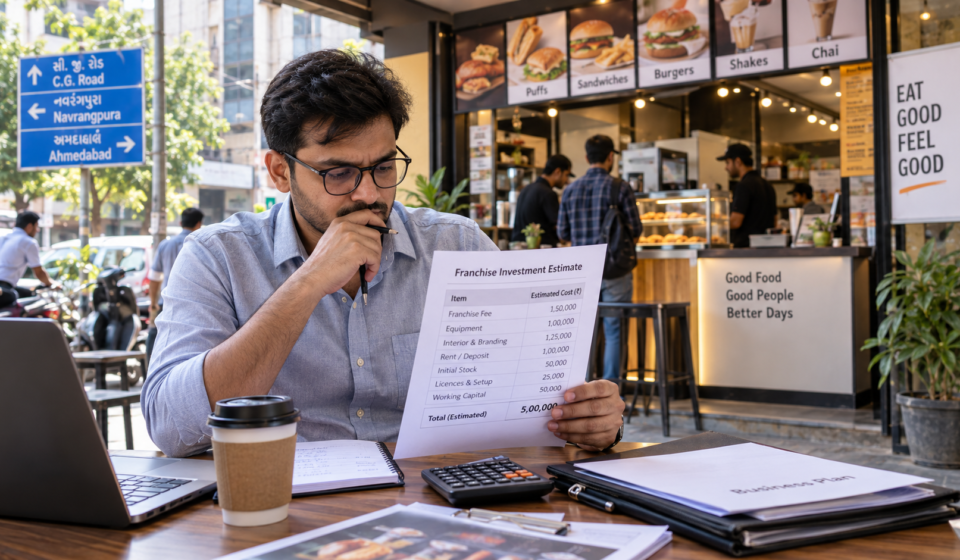
₹5 lakh can be enough to enter some small-format food franchise models, but it should not automatically be treated as the complete amount needed to open and operate an outlet. Franchise fees, equipment, interiors, rent deposits, licences, opening stock and working capital can all affect the final amount.
That distinction matters for anyone searching for a ₹5 lakh food franchise in Ahmedabad. The number advertised by a franchisor may describe the setup cost, while the investor may need additional cash to operate the outlet until sales become stable.
Quick Highlights
- ₹5 lakh franchise investment does not necessarily mean ₹5 lakh is your total cash requirement.
- Franchise fees are only one part of the investment.
- Rent deposit, initial stock and working capital can sit outside the headline investment figure.
- Smaller formats are generally more compatible with lower budgets than full dine-in outlets.
- A franchisor should provide an itemised investment estimate before you pay any fee.
- AND 51 currently publishes a total capital range of ₹4 lakh to ₹8 lakh, placing ₹5 lakh near the lower end of its stated range.
What does a ₹5 lakh food franchise actually cover?
There is no universal ₹5 lakh formula.
Depending on the franchise, the money may cover some combination of:
- Franchise or brand fee
- Kitchen equipment
- Interiors and branding
- Point-of-sale equipment
- Initial inventory
- Licences and registrations
- Installation and setup
- Opening marketing
The important question is not simply “Is the franchise ₹5 lakh?”
The better question is:
“Exactly which expenses are included in the ₹5 lakh, and which expenses will I have to pay separately?”
That distinction can change the amount an investor actually needs.
Is ₹5 lakh the complete investment or only the setup cost?
Usually, investors should not assume that the advertised setup amount is the same as the total cash they need.
For example, suppose a franchise requires ₹5 lakh for its initial setup. If the investor also has to pay a property deposit, advance rent, opening stock and early operating expenses separately, the actual cash requirement will be higher.
This is why a franchise quotation should be divided into two parts:
1. One-time setup costs
These may include:
- Franchise fee
- Equipment
- Interior work
- Signage
- POS system
- Licences and installation
2. Operating cash
This is the money available after opening for expenses such as:
- Rent
- Salaries
- Raw materials
- Electricity and gas
- Packaging
- Delivery commissions, if applicable
- Local marketing
- Repairs and unexpected expenses
The second category is often overlooked when investors focus only on the franchise fee or setup cost.
Why working capital matters in a ₹5 lakh budget
Working capital is the money an outlet uses to keep operating while revenue builds.
This is particularly important for a first-time franchise investor. A business may have a fully equipped kitchen on opening day and still face a cash shortage if sales take time to reach the expected level.
Petpooja’s investor guidance also identifies working-capital management as a major issue for food businesses and warns investors to consider the money required after the outlet opens.
That means an investor with exactly ₹5 lakh in available cash should be careful about committing the entire amount to the initial setup.
₹5 lakh invested in the outlet is not the same as ₹5 lakh available to run the business.
Does rent and the security deposit fit into ₹5 lakh?
This depends heavily on the location and the franchise format.
Ahmedabad is not one uniform commercial market. The cost of taking a shop in a high-footfall commercial area can be very different from operating from a smaller neighbourhood location or a compact takeaway format.
The deposit is also important.
Consider a simple example:
If an investor has ₹5 lakh in total available capital and spends most of it on equipment, interiors and franchise-related costs, even a relatively modest property deposit can leave very little cash for day-to-day operations.
That is why location should be evaluated after understanding the total capital requirement, not simply by asking whether the monthly rent looks affordable.
This issue also connects directly with Article #1 in this series: a food franchise can look attractive at the headline investment level while the actual outlet economics depend on rent, staffing, operating costs and sales.
What happens if the outlet needs extra equipment or interior work?
This is another area where investors should avoid verbal estimates.
A franchise may advertise a standard investment based on a particular outlet size and format. Your chosen property may require additional electrical work, ventilation, plumbing, civil work, signage or equipment.
Those costs can change the final investment.
Before signing, ask the franchisor for:
- A standard equipment list.
- A standard interior specification.
- The estimated cost of each item.
- A list of items that are excluded.
- The maximum expected variation from the quoted investment.
- Responsibility for any additional civil or electrical work.
The objective is simple: turn the headline investment into an itemised project cost.
Can ₹5 lakh realistically work for a food franchise in Ahmedabad?
Yes, but only for the right format and only if the full cash requirement fits the investor’s financial capacity.
Current franchise offerings show that lower-investment food models can exist, particularly in compact formats. A 2026 Ahmedabad F&B franchise event, for example, listed opportunities starting around ₹5 lakh, while larger QSR and dine-in formats required substantially more capital.
But “starting at ₹5 lakh” should not be interpreted as “every outlet can be opened and operated with exactly ₹5 lakh.”
The format matters.
A compact takeaway, kiosk or small-format outlet may have a very different capital requirement from a larger dine-in restaurant.
The location matters too.
And the investor’s financial runway matters just as much as the opening cost.
whether a food franchise in Ahmedabad is a good investment
Where does AND 51 fit in the ₹5–8 lakh range?
AND 51 provides a useful Ahmedabad example because the brand currently publishes a ₹4 lakh to ₹8 lakh total capital investment range for its franchise model.
Its published information lists:
- ₹1.5 lakh franchise/brand fee
- ₹2.5 lakh–₹6.5 lakh for equipment and interiors
- ₹4 lakh–₹8 lakh total capital investment
- 150–300 sq ft space requirement
- 0% royalty/commission
- 2–3 staff as the stated staffing requirement
AND 51 also publishes approximately ₹5.5 lakh as the figure for a standard 150–300 sq ft setup.
For an investor with exactly ₹5 lakh, the important point is not that the brand is “within budget” or “outside budget.”
It is that ₹5 lakh sits close to the lower end of AND 51’s published investment range. The investor should therefore confirm in writing whether the quoted amount includes the particular property’s deposit, additional civil work, licences, opening inventory and working capital.
The published gross-margin figure should also not be confused with net profit. Gross margin does not account for every operating expense an outlet may face.
What should you ask a franchisor before paying?
Before paying a franchise fee, ask for an itemised answer to these questions:
- What exactly is included in the quoted investment?
- Is the franchise fee refundable under any circumstances?
- Is rent included?
- Is the security deposit included?
- Are licences included?
- Is opening stock included?
- Is equipment included?
- Is installation included?
- Who pays for electrical, plumbing and civil work?
- What monthly costs should I expect after opening?
- Is there any royalty, technology fee or marketing fee?
- What working-capital amount does the franchisor recommend?
- What happens if the outlet takes longer than expected to reach break-even?
- Can I speak to existing franchisees?
- What territory protection is provided?
- What are the renewal and exit terms?
If the answers are not clear, the ₹5 lakh headline number is not enough to make an investment decision.
The real question is not “Can I start with ₹5 lakh?”
For an investor in Ahmedabad, the better question is:
“How much cash will I need from the day I sign the agreement until the outlet can comfortably fund its own operations?”
That number may be higher than the advertised franchise investment.
A ₹5 lakh budget can make sense for a compact food business if the format, location and cost structure fit the budget. But an investor should not spend the entire ₹5 lakh on opening day and assume the business will immediately become self-sustaining.
The next step is to examine the factor that can change those numbers most dramatically in Ahmedabad: location.
That is why the next article in this series will look at how to choose a food franchise location in Ahmedabad — and why a cheaper shop is not always the cheaper business.