





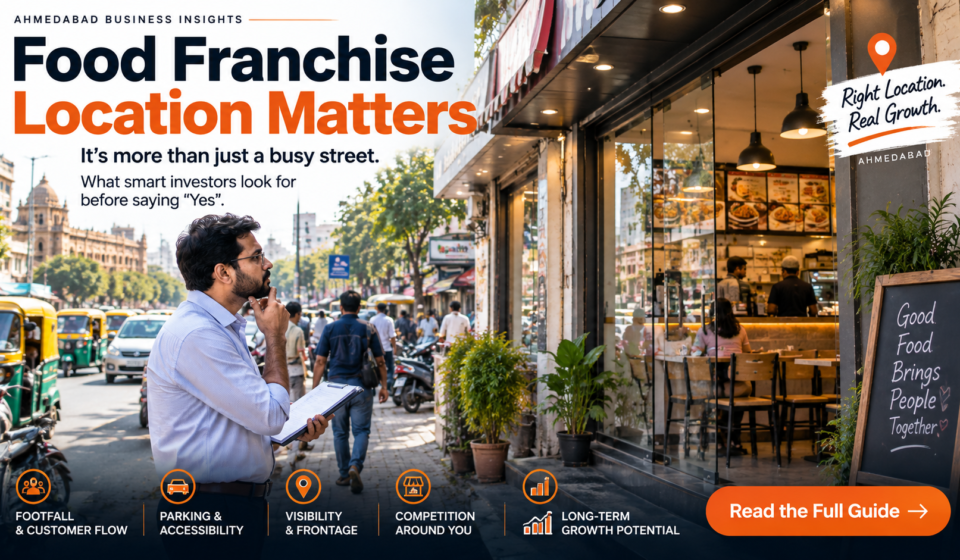
How to Choose a Food Franchise Location in Ahmedabad
Choosing a location is one of the biggest decisions when starting a food franchise in Ahmedabad. A shop with high footfall can still underperform if the rent is too high, while a less prominent location can work if it has the right customer base, access and operating costs.
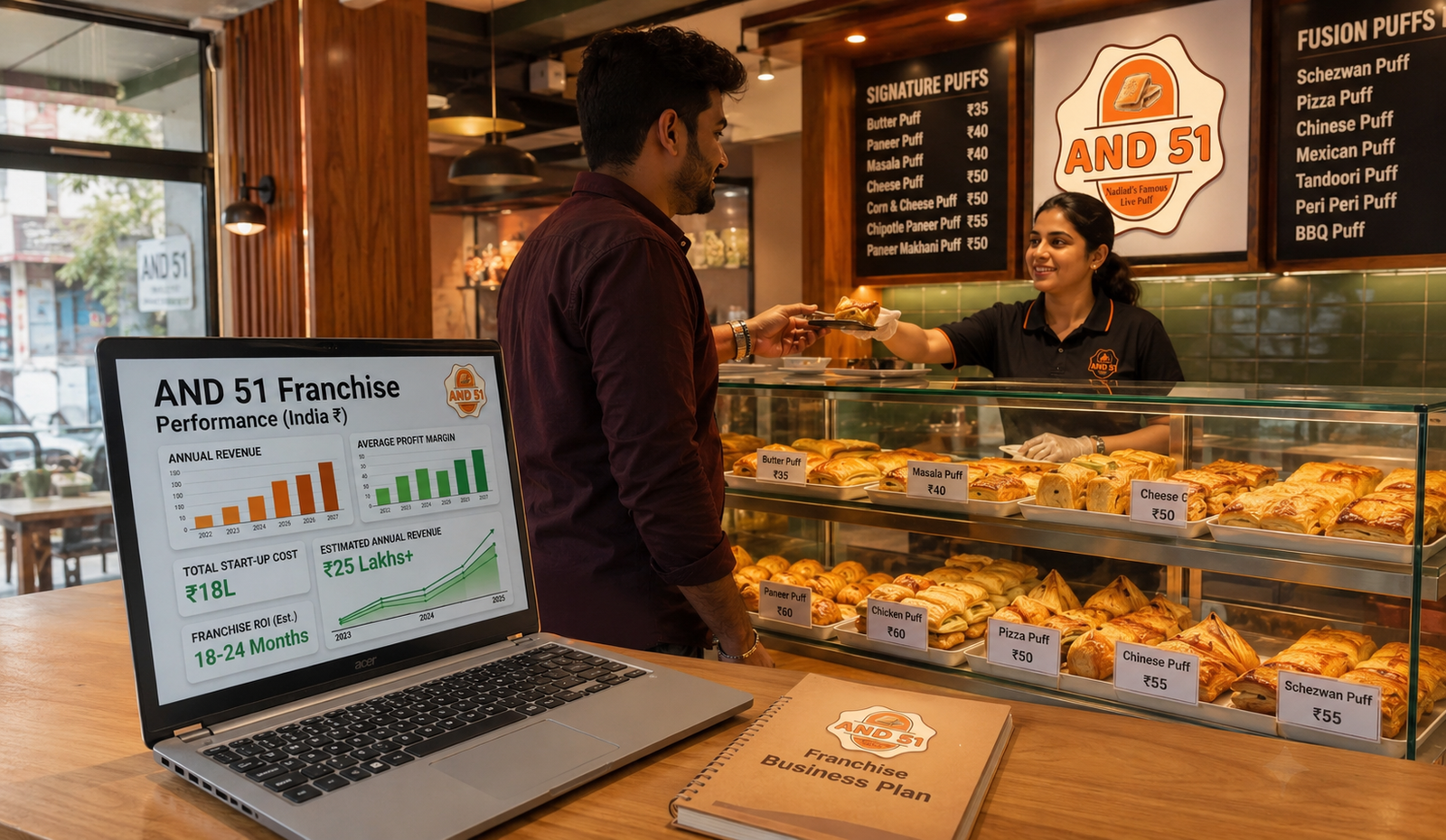
For a franchise investor, the question is therefore not simply “Which is the best area in Ahmedabad?”
It is:
“Which location can support this particular food business at a sustainable cost?”
Why location matters so much for a food franchise
Food businesses depend on more than the number of people passing a property.
The relevant questions are:
- Who passes the location?
- At what times?
- Are they likely to buy the product?
- Can they easily stop or enter?
- Is parking available?
- How strong is nearby competition?
- Can delivery orders reach the area efficiently?
- Can the business afford the rent?
Ahmedabad’s food market is competitive. A 2025 report by The Times of India cited industry sources saying the city had around 10,000 food outlets and that rising costs, competition and changing walk-in behaviour were putting pressure on restaurant businesses.
That makes location selection an economic decision, not just a visibility decision.
Should you choose the busiest road?
Not necessarily.
A high-traffic road can give a food outlet visibility, but visibility does not automatically translate into customers.
For example, a location may have heavy vehicle movement but limited pedestrian access. Another may have fewer passing vehicles but strong demand from nearby residents, offices, colleges or other regular customers.
The investor should therefore measure relevant footfall, not simply total traffic.
A useful site visit should cover different periods:
- Morning
- Lunch
- Evening
- Weekend
Observe who is actually using the area and what competing businesses are doing.
Rent should be tested against the business, not the neighbourhood
One of the biggest mistakes is deciding on a property because the area is popular and then trying to make the business fit the rent.
Ahmedabad has seen food businesses adapt to high commercial real-estate costs. A Times of India report noted that some food outlets moved to higher floors because rents could be considerably lower than prime ground-floor space, although accessibility can become a concern.
The lesson for a franchise investor is straightforward:
Do not decide the rent you can afford by looking at the locality alone. Work backwards from the outlet’s expected economics.
A ₹50,000 shop is not automatically cheaper than a ₹80,000 shop if the first location generates substantially less business.
At the same time, paying a premium rent simply for a prestigious address can put unnecessary pressure on a small-format outlet.
Footfall is useful only when it matches the customer
Different food concepts depend on different customer groups.
A product aimed at students may benefit from proximity to colleges and coaching centres.
A family-oriented outlet may need residential catchments, parking and easy access.
An office-focused concept may depend heavily on weekday lunch demand.
A delivery-oriented outlet may place greater importance on kitchen efficiency, access for delivery partners and the size of the delivery catchment.
This is why investors should first understand the customer profile of the franchise and then assess the location.
Competition is not always a bad sign
Seeing several food outlets nearby does not automatically mean you should reject the property.
Competition can indicate that customers already visit the area for food.
The more important questions are:
- How many direct competitors are there?
- What do they sell?
- What price points do they operate at?
- Are they busy throughout the week or only on weekends?
- What customer segment do they attract?
- Is there an unmet demand?
A location with ten unrelated food outlets may present a different competitive situation from a street where several outlets sell almost the same product.
Check accessibility before signing the lease
A customer may like the product but still choose another outlet if reaching yours is inconvenient.
Check:
- Road visibility
- Entry and exit
- Parking
- Walking access
- Traffic movement
- Nearby public transport
- Delivery pickup access
- Signage visibility
- Whether customers can quickly stop for takeaway orders
For food businesses, convenience can be particularly important for repeat purchases.
Do not ignore delivery
The traditional location model focused heavily on walk-in customers. That is no longer enough for many food businesses.
Ahmedabad’s food sector has experienced a shift toward delivery, with industry reporting in 2025 pointing to delivery platforms affecting walk-in traffic and putting additional pressure on some large-format outlets.
For a franchise investor, that means the site should be evaluated for both:
Walk-in potential + delivery potential.
A location that looks weak from the street may still work for a delivery-led format. But the reverse can also happen: a visually prominent property may carry a rent that the business cannot support.
Compare the property with the franchise format
This is where many investors make a mistake.
A location should not be selected independently of the outlet format.
A compact takeaway model may not need the same space or frontage as a dine-in restaurant.
Similarly, a small food outlet may not need to pay for a premium high-street property if most of its sales can come from repeat local customers and delivery.
Before taking a property, establish:
- Required outlet size.
- Expected seating requirement, if any.
- Kitchen and storage requirements.
- Frontage requirement.
- Customer parking requirement.
- Delivery access.
- Utility requirements.
- Signage restrictions.
- Permitted food use.
- Total occupancy cost.
Ask the franchisor to evaluate the site
Before paying a property deposit, ask the franchisor whether it has a formal site-selection process.
A useful franchisor should be able to tell you what it looks for in a location and why.
Ask:
- What minimum and maximum shop size do you recommend?
- What type of catchment works for the brand?
- What rent level is considered practical?
- Do you approve locations before the agreement?
- How do you assess competition?
- What sales assumptions are being used?
- Is territory protection available?
- Are there already outlets nearby?
The franchisor’s answer can reveal whether its location strategy is based on a repeatable process or simply on finding available shops.
Visit the location before making the decision
Do not rely only on a property broker, Google Maps or a single site visit.
Visit the property more than once.
Look at the location during lunch, evening and weekends. Check competing outlets. Speak to nearby businesses where appropriate. Observe parking and traffic movement.
Most importantly, compare the actual property with the sales and cost assumptions in the franchise proposal.
The right Ahmedabad location is the one the business can carry
There is no single “best” location for every food franchise in Ahmedabad.
A premium high-street property may work for one concept and be financially unsuitable for another.
A neighbourhood location may appear less attractive but provide a stronger combination of rent, repeat customers, accessibility and delivery demand.
For investors, the goal should be to find the right economic fit, not simply the most famous address.
Before signing a lease, make sure the location works on four levels:
Customer demand → accessibility → competition → occupancy cost.
If one of those four does not make sense, a good franchise brand cannot automatically fix the location problem.
The next question is what happens after the outlet opens — particularly if actual sales are lower than the projections used when making the investment decision.